
Ask your data anythingDecide in minutes
Train the agent on your data, your business rules and your knowledge in 30 days.
Today it runs at companies in retail, telco and industrial. Bring us your use case — we'll tackle it together.

















Every team drowns in data it can't query on its own
And every answer waits on an overloaded data team — days of waiting for a single number.
- ✕it doesn't know where to get the information and hallucinates numbers.
- ✕it's insecure: you can't control which employee accesses what data.
- ✕it becomes outdated in a few months and the knowledge stays with the person, not the company.
In this post, Anthropic documents how their own team took their internal agent's accuracy from 21% to over 95% — with serious data engineering work behind it. It confirms that precision is custom to every use case and needs to be actively maintained — otherwise it degrades within months.
The model isn't the hard part: everything that needs to surround it is.
The same system, configured for your area
Today it runs at companies in retail, telco and industrial. Bring us your use case — we'll tackle it together.
Why Wilab gets it done in 30 days — when others can't
The AI model is a commodity. The data engineering isn't.
Our edge isn't the model — it's turning your data, business rules, and domain knowledge into a reusable system. Since 2018 we've built real-time data pipelines for telecoms — where a wrong number costs millions.
Built on MCP,
shaped by context.
Pulse Agent is not a chatbot bolted onto a dashboard. It talks to your warehouse through a Model Context Protocol server, loads the right skill for the right step, promotes queries to reusable metrics, and orchestrates the downstream work.
Under the hood
Wired to your
warehouse
Prompt, context and memory fuse into a reasoning loop that talks to your warehouse through Wilab MCP — Postgres, Snowflake, BigQuery or ClickHouse, whichever you run.
Bring your own Postgres, Snowflake, BigQuery or ClickHouse. Wilab MCP exposes tables and views as typed tools the agent can reason over safely.
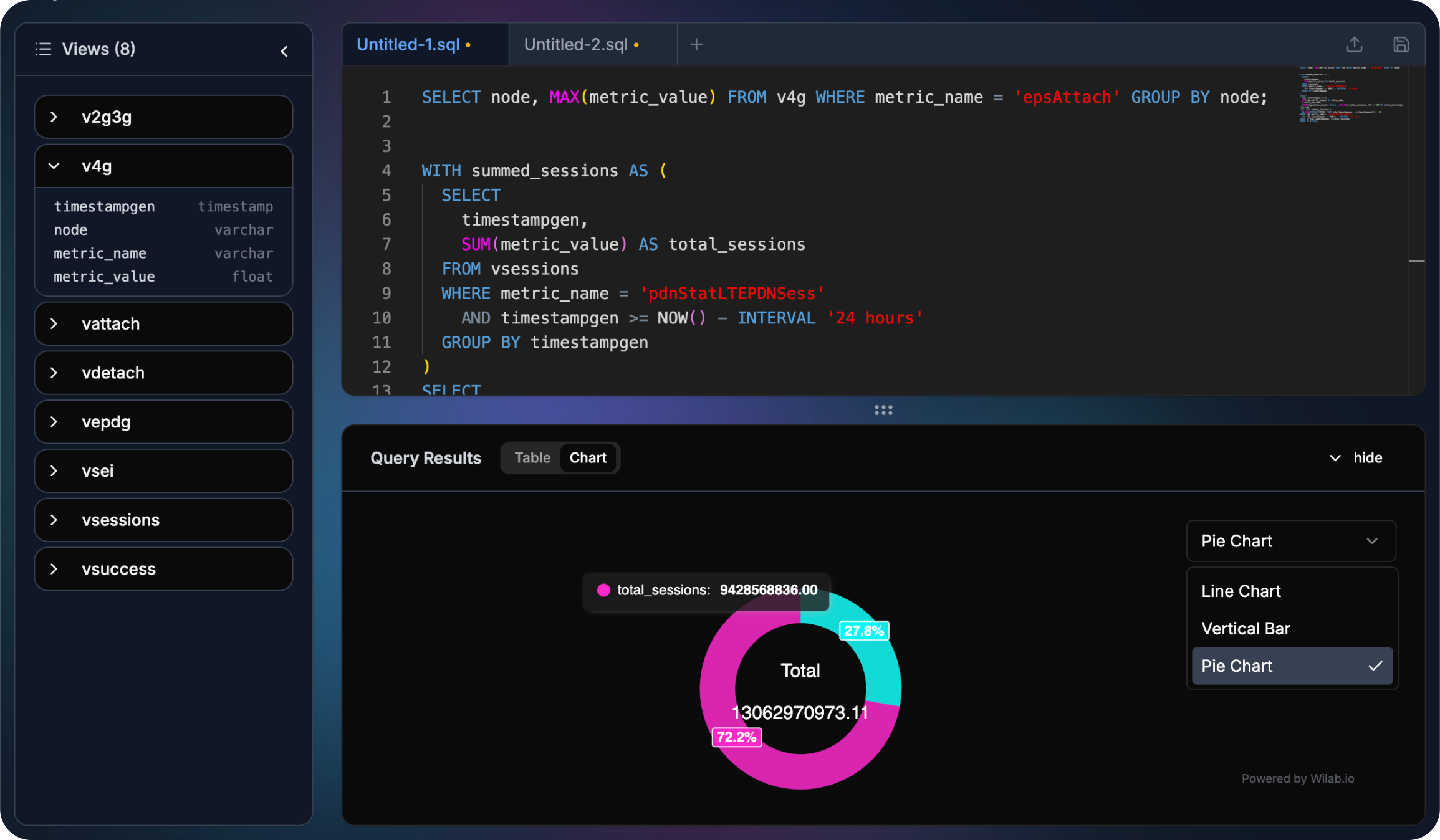
Each chart or table is paired with the exact SQL that produced it — inspect, edit, re-run or promote to a production view in one click.
Ask for a redistribution plan, a supply decision, a cohort breakdown — receive a response you can ship to Slack, email or your ops tooling.
Not prompts
Context
Every agent call is a choreography of skills, memory, tools and compressed history. Pulse Agent ships with a skill library informed by context-engineering research, so the model spends its tokens on your problem — not on remembering how to work.
- Context fundamentals
- Degradation patterns
- Compression strategies
- KV-cache compaction
- Multi-agent patterns
- Memory systems
- MCP tool design
- Filesystem context
- Hosted agents
- Context optimization
- Latent briefing
- Evaluation frameworks
- Observability hooks
- BDI mental states
- Belief revision
- Intention ladders
- Goal stacks
Only the skill required by the current step enters context. Finished skills get pruned. Long sessions stay fast.
Append-only sessions, entity tracking, and a knowledge graph over your data catalog — so the agent improves session over session.
LLM-as-judge evaluations, rubric scoring, pairwise comparison — baked in so you can measure the agent against your ground truth.
Insight is
never the
last step
Every workflow is a graph. Trigger the agent on a schedule, an event or a webhook. Chain tool calls, branch on thresholds, and fan out to Slack, Linear, email, or your own APIs — all as code, reviewable in a PR.
The SQL
behind every
answer
A safe playground to explore sources and validate transformations. Craft queries in natural language, edit the result, promote them into production metrics with a single click — no copy-paste, no lost lineage.
- Natural-language drafts: Describe the metric; the studio proposes the SQL and the chart type.
- Version-safe edits: Every query lives as a named view with an owner, a diff history, and a test suite.
- One-click promotion: Ship a draft to a production view without leaving the studio; downstream dashboards pick it up automatically.
- Back-channel to the agent: Every answer in the chat links back to the underlying SQL — open, edit, re-run.
Try it with
your own data
No migrations. First use case live in ~30 days.
Start with the capacity you need. Scale as you grow